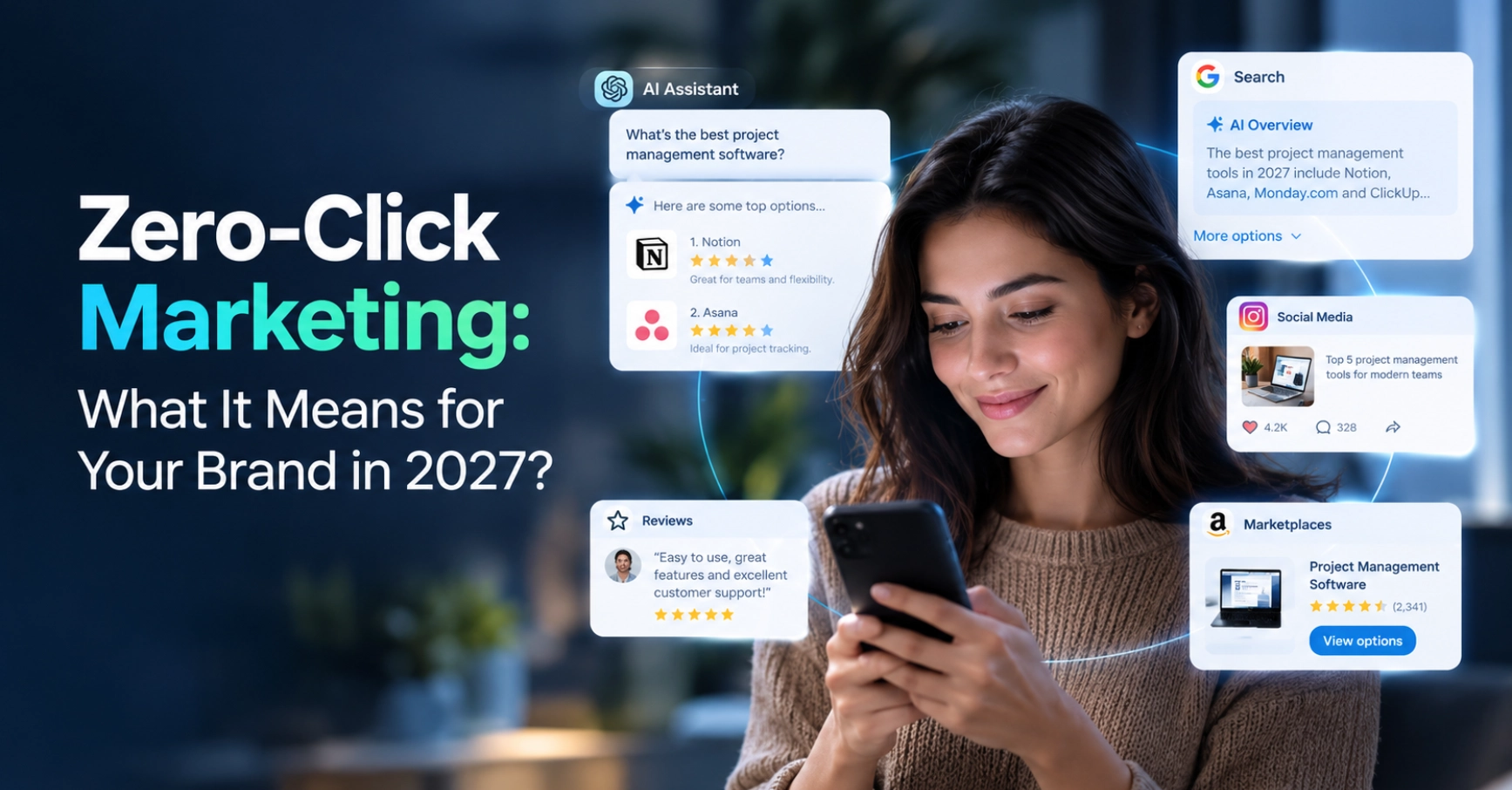
Picture a buyer researching a new software tool. She asks an AI assistant for options, watches a couple of short videos, and skims reviews on a marketplace. By the end of the afternoon she has a shortlist, and your brand is on it. Your website never saw her.
This is zero-click marketing: customers discovering, comparing and even deciding without ever visiting your site. For leaders who have treated the website as the centre of the funnel, that is unsettling. But it isn't the end of the website. It's a change in where the customer journey begins, and in who gets to shape it.
What "zero-click" means today
The term used to describe a quick answer on a search page, like a weather forecast or a sports score. Today it covers any place where people learn about a brand without clicking through: AI answers, search summaries, social feeds, marketplaces and more. These are now part of your marketing surface, whether you planned for them or not. The customer journey now has several starting points, and most of them sit outside the pages you own.
How big is the shift?
Big enough to plan around. One 2026 analysis found that zero-click searches reached 68% of US Google queries, roughly two in three. Pew Research found that users who saw an AI summary clicked a traditional result in 8% of visits, compared with 15% when no summary appeared.
Google sees it differently. It says total organic click volume to websites has been relatively stable year over year, and that the clicks which remain are higher quality. Both views can hold: traffic is moving between sites, and the visitors who do arrive are often further along in their decision. The takeaway from the latest digital marketing insights is that the trend is real, even if the exact numbers vary by study.
Where customers discover you without clicking
AI answers and search summaries. Search engines increasingly write the answer themselves. Ranking first no longer guarantees you are mentioned in it. In practice, that means clear pages that answer real customer questions, up-to-date facts, and a presence in the places AI tools tend to draw from, such as reviews, forums and trusted publications.
AI assistants. People now ask ChatGPT, Gemini or Claude what to buy and who to trust. In one study, consumers who received a brand recommendation from ChatGPT were 2.5 times more likely to visit that brand's site within seven days. Most of that influence never appears as a neat "AI referral" in your analytics.
Social discovery. Among Gen Z, 41% turn to social media first when looking for information, compared with 32% who prioritise Google. Short videos, creator reviews and community threads shape opinions long before a brand's own page does.
Marketplaces. A 2024 Jungle Scout survey found that 56% of US online shoppers started product searches on Amazon. In many categories, the marketplace is where your brand is compared and judged. Reviews, photos and clear descriptions do much of the selling there.
What starts to break inside the business
The first casualty is measurement. A meaningful share of "direct" traffic is likely AI-driven visits that lost their source. One analysis found that direct traffic averages roughly 31% of total sessions across its panel. Sessions, clicks and last-touch attribution now tell an incomplete story.
Strategy follows. Content built only to capture traffic is the most exposed. Reports can look flat while brand influence grows, and teams argue over credit. Without new metrics, leaders risk cutting what is quietly working.
There is also a brand risk. When an AI tool summarises your company, you do not control the wording. Outdated pricing, old product names or a competitor's framing can travel further than your own messaging, and you may never see it happen.
The website's new job
If fewer people arrive casually, the ones who do arrive carry more intent. They have already read the summary, watched the review and compared the options. They are not coming to learn what you do. They are coming to confirm, to go deeper, or to buy. Think of it as the difference between a shop window and a consultation room. The window now sits elsewhere. Your site is where the serious conversation happens.
What doesn't change
People still want brands they can trust. The click is rarer, but often more valuable: AI-referred retail traffic converted 42% better than non-AI traffic in March 2026.Reputation, reviews and real expertise decide who gets recommended, whether by an algorithm or a friend. Trust is built over time, which is good news for brands that have invested in being genuinely useful.
A leadership agenda for this quarter
The best digital marketing insights are the ones a team can act on, so start here:
- CMOs: Track brand mentions, branded search growth and assisted conversions alongside traffic.
- CTOs and CIOs: Keep product, pricing and support information accurate, structured and consistent everywhere. Machines now read it before humans do.
- Founders: Invest in reputation you own, such as reviews, community and original data. Treat your website as the place for deeper decisions.
- Every team: Ask one simple question: where are customers learning about us that we cannot see? Then check what AI tools say about your brand today, and fix what is wrong.
The question that matters now
Zero-click isn't a story about the website disappearing. It's about influence moving earlier and further from home. Brands that show up helpfully in these spaces will still earn the visit that counts, and they will arrive with trust already built.
The question is no longer "How do we get more clicks?" It is "Are we worth recommending before anyone clicks?"
References:
- Pew Research Center, "Google users are less likely to click on links when an AI summary appears in the results" (July 2025)
- Google Search blog, "AI in Search is driving more queries and higher quality clicks"
- Zero-click share of US Google queries (68%, early 2026): Cognizo, "Google AI Overviews statistics for 2026"
- ChatGPT recommendation lift (2.5x): Similarweb behavioural study, as reported by Spangle Insights, "State of AI Shopping: 2026 Data"
- Gen Z social-first search (41% vs 32%): Sprout Social, "Social media demographics to inform your 2026 strategy"
- Amazon product-search share (56%): Jungle Scout 2024 survey, as summarised by Practical Ecommerce
- Direct traffic share (about 31%): Higoodie, "2026 AI Search Traffic Report"
- AI-referred retail conversion (42%): Adobe Digital Insights data, as reported by Cognizo, "ChatGPT AI visibility statistics for 2026"
Frequently Asked Questions (FAQs)
Zero-click marketing is a marketing environment where customers discover, compare or evaluate brands without clicking through to the brand's website. This can happen through AI answers, search summaries, social feeds, marketplaces, reviews and other third-party platforms.
Customers increasingly discover information outside company websites. AI search summaries, AI assistants, social platforms and marketplaces can influence a buying decision before someone visits a brand's website.
AI search and AI assistants can answer customer questions, recommend brands and summarise information without requiring users to visit individual websites. This means brands need accurate, useful and trustworthy information available across the sources AI systems may use.
No. The role of the website is changing. Instead of being the first place every customer learns about a brand, the website increasingly serves people who already have some awareness and want to verify information, compare options, go deeper or buy.
Brands should provide clear answers to customer questions, keep facts and product information current, build genuine expertise and maintain a presence across trusted sources such as reviews, forums and publications.