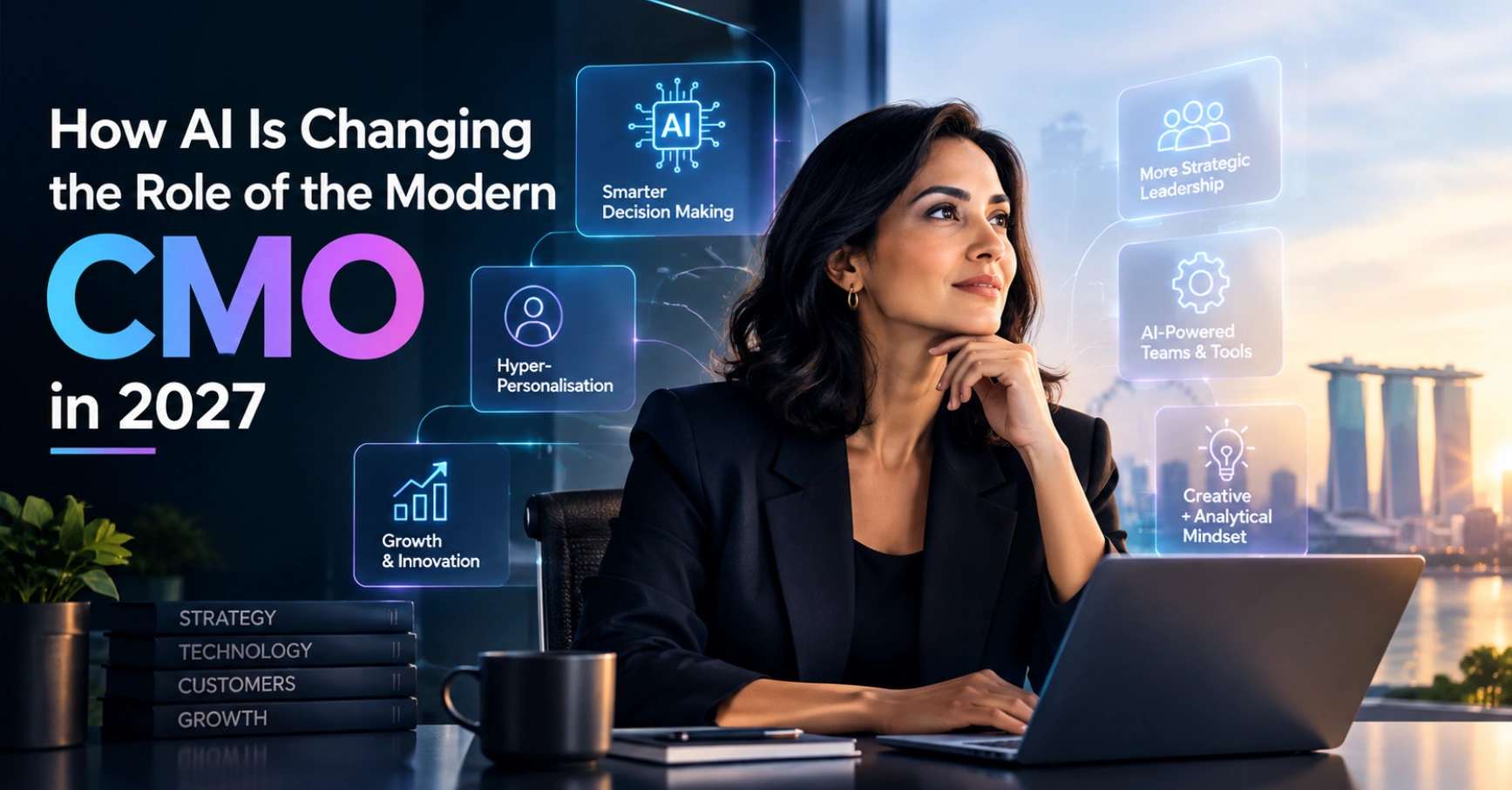
If AI can increasingly perform parts of planning, analysis, content creation, personalization and customer interaction, what exactly should the CMO be responsible for? That question is quietly reordering the top of the marketing org chart faster than any technology cycle in recent memory.
Gartner's latest research puts a number on the unease: a survey of 402 senior marketing leaders found that 65% of CMOs believe advances in AI will dramatically transform their role within the next two years. That figure alone marks a shift. AI has moved from an efficiency tool bolted onto existing workflows toward something with the reach to redraw the marketing operating model itself.
The evidence doesn't point to one script for every organization - some are moving fast, most are not - but it does point to a common set of forces every CMO now has to reckon with.
The CMO’s New Role in the Age of AI
For most of the last two decades, the CMO's job was, at bottom, about execution: build the plan, brief the agencies, run the campaigns, report the numbers. AI doesn't eliminate that job so much as it makes execution the part of the role that needs the least of the CMO's personal attention.
What's expanding instead is orchestration - coordinating human teams, AI systems, AI agents, customer data, technology platforms, brand strategy and business objectives into something coherent. BCG's global survey of 300 CMOs found that while 96% say AI is transforming marketing end to end, only about one - third have implemented agent - led operating models. The gap between conviction and execution is, in effect, the current job description.
None of this requires the CMO to become an AI engineer. It does require working literacy: understanding what a given AI system can and can't be trusted to do, where it needs a human check, and how its outputs connect back to a business result. That judgment, not technical depth, is becoming the differentiator.
AI Is Changing How CMOs Understand Customers
Segmentation, predictive analytics and personalization aren't new marketing disciplines. What's changing is their granularity and speed. Traditional personalization operated at the level of the campaign - a tailored email, a retargeted ad. The emerging model works continuously, adjusting to behavior across channels in something closer to real time.
Adobe's research found that organizations describe the breakthrough customer experience they're chasing as highly personalized in real time (80%), seamless across digital and physical touchpoints (72%), and AI- powered while still feeling human and brand- aligned (60%). Getting there depends less on better AI models than on whether an organization actually knows its customer well enough, consistently enough, to make good on that ambition.
The Rise of Human + AI Marketing Teams
Marketing's operating model is moving through recognizable stages: AI assisting individual tasks, then AI supporting entire workflows, then - for a smaller group of organizations - AI agents handling parts of marketing operations with limited supervision.
Most organizations sit closer to the first stage than the third. BCG found that only 8% of CMOs are running campaigns in which multiple AI agents operate autonomously, while 42% still use generative AI mainly to assist humans with individual tasks.
That's a wide gap between what CMOs say about AI's transformative potential and what their teams have actually built. Human judgment remains the load- bearing element for strategy, creative direction and the calls that don't have a clean rulebook - but the share of routine work sitting entirely with people is shrinking.
Data Becomes a CMO - Level Strategic Issue
AI performance is bounded by data quality, which turns data into a leadership problem rather than a purely technical one. Adobe found that 78% of CMOs cite data integration and quality as the top barrier to adopting agentic AI.
Salesforce's research among marketers in India tells a similar story from a different angle: marketing teams with satisfactorily unified customer data are 1.4 times more likely to regularly engage customers and 1.6 times more likely to use AI agents to scale their efforts than teams working with disjointed data.
The implication is straightforward, if not always comfortable: AI strategy without a reliable data foundation is difficult to scale, no matter how sophisticated the model. That pushes CMOs into closer, more permanent collaboration with CIOs, CTOs and data leaders - not as a courtesy, but as a precondition for the outcomes AI is supposed to deliver.
Customer Experience Will Become an AI Leadership Issue
As AI agents and conversational interfaces take on more of the customer relationship - service, recommendations, post - purchase engagement, brand discovery - the line between "marketing" and "customer experience" gets harder to hold. As noted above, most organizations want AI - driven experiences to still feel human and brand - aligned, not purely automated.
That expectation puts a specific responsibility on the CMO: making sure the experience a customer gets from an AI agent doesn't contradict the one they'd get from a person, in tone, judgment or follow- through. That's a brand- consistency problem as much as a technology one, which is exactly why it tends to land on marketing's desk rather than IT's.
Brand Governance Will Matter More
More autonomous AI systems bring a longer list of things that can go wrong in public: off- brand content, hallucinated claims, privacy missteps, biased outputs, unclear permissions for what an agent is and isn't allowed to commit the brand to. None of this is reason for alarm, but it is reason for structure.
Governance - who approves what, what an AI agent can say on the brand's behalf, how errors get caught before customers see them - is increasingly a marketing leadership function rather than something to hand off entirely to legal or IT. The CMOs building this structure now will be the ones least exposed when something inevitably goes wrong later.
Measuring AI Beyond Productivity
Producing more content, or clearing a campaign backlog faster, is not the same as marketing impact. Yet productivity is often the easiest thing to measure, which makes it tempting to treat as the whole story. BCG's research suggests the gap between activity and outcome is real: just 31% of B2C CMOs and 20% of B2B CMOs report measurable revenue impact from their AI transformations so far.
The more useful frame ties AI investment to outcomes that already mattered before AI arrived: revenue, acquisition cost, lifetime value, retention, conversion, satisfaction. AI output is not the same thing as marketing impact, and CMOs who conflate the two will struggle to defend their budgets when growth slows.
What CMOs Should Prepare for in 2027
A few priorities show up consistently across the research, independent of any single vendor's roadmap:
- Build AI literacy across marketing leadership – not just within specialist or analytics teams, but at the top of the function.
- Audit workflows deliberately to decide what should be automated, augmented, or kept firmly human-led.
- Invest in first-party data and integration before scaling agentic AI further – the barrier is rarely the model.
- Set clear AI governance – approval paths, permissions, and accountability – before autonomy expands, not after an incident forces it.
- Redesign team structures around human-AI collaboration rather than bolting AI tools onto the existing org chart.
- Tie AI measurement to business outcomes, not activity volume or content output.
- Pilot AI agents deliberately, scaling human oversight to the stakes of what’s being automated.
None of these are tool- specific, which is the point: they should hold regardless of which AI platforms happen to be fashionable by the time 2027 actually arrives.
The CMO of 2027 will not necessarily be the executive who uses the most AI. The role will increasingly belong to the leader who understands where AI can create leverage, where human judgment remains essential, and how to connect both to sustainable business growth.
Frequently Asked Questions (FAQs)
AI is taking over more routine analysis, content, personalization, and workflow tasks. This allows CMOs to focus more on strategy, customer experience, AI governance, team design, and connecting marketing activity to business growth.
CMOs will need practical AI literacy rather than deep technical expertise. They should understand AI capabilities and limitations, evaluate outputs, identify useful use cases, manage risks, and know where human judgment is still essential.
AI is more likely to change the CMO’s responsibilities than eliminate the role. As execution becomes increasingly automated, leadership, strategic judgment, brand direction, governance, and business decision-making become more important.
Start by building AI literacy across the team, then identify workflows that can be automated or augmented. CMOs should also establish clear governance, strengthen data foundations, and redesign roles around effective human-AI collaboration.
CMOs should look beyond productivity metrics such as content volume or time saved. AI initiatives should be connected to measurable outcomes such as revenue, conversion, customer acquisition cost, retention, lifetime value, or customer satisfaction.